


Camino de la Ronda – Day 1 of 3 on the Costa Brava
A 12 km GR‐92 coastal hike from Palamós to Calella de Palafrugell, passingcoves, viewpoints and classic Costa Brava scenery on the first day of this 3‑day route
Views:
3k
About Camí de la Ronda DAY 1 in Costa Brava
This three‑day walking (and swimming) adventure along the GR‑92 Camí de Ronda is the result of weeks of planning — studying bus routes, checking hotel availability, calculating daily distances and researching every cala worth stopping for. It’s a route that links what I believe is the most beautiful stretch of coastline on the Costa Brava, from Palamós to Begur, passing coves, pine forests and some of the region’s most charming whitewashed fishing villages: S’Alguer, Calella de Palafrugell, Llafranc, Tamariu, Aiguablava, Fornells, Sa Tuna and Aiguafreda.
By the time the morning of departure arrived, I felt that familiar mix of excitement and apprehension you only get before a trip you’ve planned down to the last detail. Standing at the bus stop with my rucksack, I kept thinking: Have I missed something? Did the hotel booking actually go through? What if I end up sleeping outside and get eaten alive by mosquitos? That’s the charm — and the risk — of a linear coastal hike. Once you step onto the trail, you’re committed to moving forward — there’s no easy way to undo the day.
As the bus rolled off the motorway and into the outskirts of Palamós, the nerves shifted into focus. I knew my stop was coming up — and that it wasn’t the end of the line — so I had to be ready to get off at the right moment and not add additional kilometers to my hike. Once off the bus I powered up the route map on my Wikiloc phone app and followed the route leaving Palamós. I toyed with the idea of grabbing breakfast in Palamós, but decided to push on — I knew there would be far more scenic places to stop later.
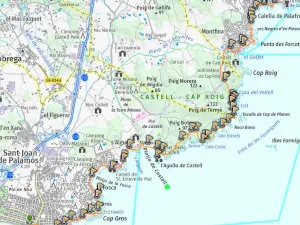
This page covers that first day: the route, the swims, the viewpoints, and the small moments that make this section of the Camí de Ronda 12 km walk from Palamós to Calella de Palafrugell. The reward at the end of the day is Calella de Palafrugell — a postcard‑perfect whitewashed village with narrow lanes, rocky coves and excellent seaside restaurants.
Because the route is linear, the most practical way to complete the three days is by using Moventis Sarfa‑Bus services to reach Palamós and return from Begur at the end of day 3.
Camí de la Ronda Vocabulary
When talking about place names, I use local Catalan vocabulary:
- Cala – Cove
- Camí – Path
- Cap – Headland
- Castell – Castle
- Platja – Beach
- Far – Lighthouse
- Poblat Ibèric – Iberian settlement ruins
- Torre – Watchtower
- Mirador: viewpoint
Image Gallery For Camí de la Ronda DAY 1 in Costa Brava
Click on any of the 99 images to open full screen gallery player. Note that viewing images is subject to our Fair Use Policy.
Visiting Camí de la Ronda DAY 1 in Costa Brava
The Sarfa bus stop in Palamós is a short 650‑metre walk from the starting point at the Marina de Palamós. From here, the GR‑92 heads north toward Cala Margarida, a tiny cluster of fishermen’s houses tucked beneath pine trees. A path behind the houses leads into forest and onto a rocky coastline with sweeping views. It’s possible to swim here, but I prefer to put in a few kilometres before the first stop.
Almost immediately after leaving town, the route begins to reward. The first viewpoint, Mirador de la Cala Margarida, offers a hilltop panorama over the cliffs and the marina of Palamós. The trail then follows a pine‑scented bluff through forest to another excellent viewpoint, Mirador del Cap Gros. Further along the Cap Gros bluffs, passing Cala Sa Tamardia, the Mirador de Sa Tamardia overlooks Platja de la Fosca — a long sandy bay protected by the ruins of Castell de Sant Esteve de Mar.
I stopped here for a light breakfast at one of the beachfront bars. The beach was tempting, but I wanted to save my swims for the most intimate calas, so I continued along the paved path past the castle ruins and on toward Caló dels Pedrots and La Roca Negra de Sant Esteve. The Pineda d’en Gori section is a beautiful stretch of pine forest with uninterrupted views of deep blue water.
The trail passes Cala Pallerida, another inviting spot to swim, but I pushed on, rounding the headland to a postcard‑perfect view of Cala s’Alguer. This is one of the most charming places on the Costa Brava — a row of whitewashed fishermen’s huts shaded by pines at the edge of a quiet cove. It’s an irresistible spot for a swim.
Leaving s’Alguer, a stone path leads through forest to Platja de Castell, a wide natural beach home to Kayaking Costa Brava Castell. At the northern end, a rising path climbs to the archaeological site of the Poblat Ibèric de Castell, with views over the tiny sea‑carved Cala Foradada. From the Iberian ruins, the cove looks accessible only by boat, though some local teenagers insisted there is a steep descent. I decided not to test it.
Beyond the Iberian settlement, the trail becomes a classic Camí de Ronda section: pine forest, rocky ledges and a string of wild coves including Cala Cobertera, Cala dels Canyers and Cala Corbs. A short detour onto Punta dels Canyers reveals the tiled floor of an old house and panoramic views of the coastline.
The path then drops onto Cala Estreta, a narrow nudist beach backed by sculpted rock formations. This is one of the most beautiful swimming spots on the route, and I stopped here for a swim and a short rest. Continuing along the beach into Cala Roca Bona, the trail climbs a rocky headland and descends to Cala Cap de Planes and Cala del Crit. At Crit beach, the route passes through a natural “eye‑shaped” opening in the cliffs — one of the most memorable features of this stage — and I took another swim here.
After climbing the stairs beside a white beach house, the route skirts inland around private properties, passing the grounds of Castell de Cap Roig before descending through a residential area to Cala el Golfet. From here, a paved coastal path leads through tunnels beneath houses — part of a project to restore the Camí de Ronda to its original coastal alignment.
The final stretch is a gentle, scenic walk along pine‑lined paths and small coves until the rooftops of Calella de Palafrugell appear. This is one of the most beautiful villages on the Costa Brava and an ideal overnight stop thanks to its hotels and excellent restaurants. I recommend La Blava restaurant, a traditional fisherman’s house overlooking Platja de les Barques — book ahead.
After dinner, the beaches of Calella — Port Pelegrí, La Platgeta, Port de Malaespina, Canadell and Els Canyissos — are perfect for an evening stroll or a late swim.
It was here that I realised I had made a mistake. Although I’m presenting this as a three‑day hike, I had originally planned it as a two‑day route (18 km and 15 km). By the time I reached Calella, it was four in the afternoon, I was exhausted, and the town was so beautiful that stopping early would have been the perfect choice. Continue to Day two to see what awaited.
Hiking The Camí de la Ronda with a dog
Dogs are generally not permitted on beaches between 1 June and the last Sunday of September, except in designated dog zones. Because this stage includes several beaches, it’s best completed with a dog outside the summer season.
Dog‑friendly beaches on this section:
- Platja de les Pots (near Palamós)
- Pineda d’en Gori (near Palamós)
In spring and early autumn, be aware of Pine Processionary Caterpillars in forested areas. The route itself presents no technical difficulties for dogs.
Where to eat in Calella de Palafrugell
You will not have a bad meal in Calella de Palafrugell, you will have amazing food and outstanding dining experiences.
-
🌐 Restaurant Fiego: specialises in grilled fish and seafood including Paella dishes.
📍 Platja del Port Pelegrí, 17210 Calella de Palafrugell -
🌐 La Blava: is a tiny and exclusive restaurant in a galleried beachfront house offering grilled fish, paella and seafood dishes.
📍 Carrer Miramar, 3, 17210 Calella de Palafrugell - 🌐 Les Voltes de Calella: beachfront seafood, paella and grilled fish. Some non fish dishes. 📍 Les Voltes de Calella, 7, 17210 Calella de Palafrugell
- 🌐 Calau: an authentic tapas bar where you sit down at a table and order drinks then go to the bar to load cocktail sticks onto your plate. Billing is done by counting the large and small cocktail sticks on your plate. 📍 Carrer de les Voltes, 2, 17210 Calella de Palafrugell
- 🌐 Taverna ca la Raquel: traditional tapas and grilled meats, sausages and village food. 📍 Plaça Sant Pere, 4, 17210 Calella de Palafrugell
-
🌐 Pizzeria Vent de Mar: Fegetsrian and gluten free pizzas on request as well as pasta and bread dishes.
📍 Carrer de Pirroig, 2, 17210 Calella de Palafrugell - 🌐 ARRR! Street food Calella: for burgers, tacos, pinchos, vegetarian options available 📍 Carrer de Codina, 6, 17210 Calella de Palafrugell
- 🌐 La Croissanteria de Calella: is an ideal place to get breakfast and a baguette to take away. 📍 Carrer de Chopitea, 3, 17210 Calella de Palafrugell
What to take with you for Camí de la Ronda DAY 1 in Costa Brava
This section of the Camí de Ronda is best enjoyed with a light pack. You’ll be walking along beaches, rocky paths and forest trails in warm weather, so focus on carrying only what you truly need. A small daypack is enough for this three‑day route if you’re staying in hotels each night.
Essentials to pack:
- Lightweight hiking shoes or trail runners – grippy enough for rocky paths but comfortable for long days.
- Swimwear – you’ll want to stop for a dip in the coves along the way.
- Microfibre towel – quick‑drying and compact to pack.
- Sun protection – sunscreen, sunglasses and a hat are vital on exposed coastal sections.
- Water – carry 2–3 litres per day; there are long stretches without refill points.
- Snacks – fruit, nuts or energy bars for the longer forested sections between beaches.
- Waterproof phone pouch (IPX8) – ideal for taking photos from the water or keeping your phone safe during swims.
- Small dry bag – useful for keeping valuables dry inside your rucksack.
Camí de la Ronda DAY 1 in Costa Brava Summary of Prices
Train/Bus Fare
Entry Ticket
Additional Information
Train/Bus Fare
Entry Ticket
Additional Information
Adult
€ 17.45
FREE
Child
€ 17.45
FREE
Notes
Bus Barcelona to Palamos 17.45 Euros
Getting to Camí de la Ronda DAY 1 in Costa Brava
Address: Palamos Sarfa Estacion Bus, Palamós, 17230
The northern Costa Brava has no rail service, so the most practical way to reach these coastal towns is by bus. Moventis Sarfa‑Bus operates route 100, which connects Barcelona with the main villages along this section of the Camí de Ronda.
Because this is a linear three‑day hike, travelling by bus works well:
- Day 1: Bus to Palamós (Estació de Autobuses) → walk to Calella de Palafrugell or Llafranc (overnight).
- Day 2: Walk from Calella de Palafrugell or Llafranc to Aiguablava or Fornells (overnight).
- Day 3: Walk from Aiguablava or Fornells to Begur (Plaça Forgas) → bus back to Barcelona.
Note: The bus times shown on my route map were accurate on the day I completed this hike. Moventis Sarfa‑Bus may adjust schedules depending on season and demand, so always check current times and prices before travelling.
The outbound journey on Day 1 is from Barcelona–Estació Nord to Palamós–Sarfa. The return journey on Day 3 is from Begur–Plaça Forgas back to Barcelona–Estació Nord.
Wikiloc Trail for Camí de la Ronda DAY 1 in Costa Brava
Please sign in with Google to view the Wikiloc Route map.
Sign in with GoogleWeather for Camí de la Ronda Palamós
Where to stay in Callella de palafrugel or Llafranc
Finding accommodation in Calella de Palafrugell or Llafranc for a single night can be challenging, especially in spring and summer when many hotels require two‑night stays. For this reason, I recommend looking at campsites with bungalow rentals or hotels slightly outside the beachfront area, where one‑night bookings are more commonly accepted.
- Sant Roc Hotel (Calella de Palafrugell) — a stunning clifftop hotel overlooking the town and beaches.
- Hotel Port‑Bo (Calella de Palafrugell) — a five‑minute walk from the centre and beaches.
- Hotel Garbi (Calella de Palafrugell) — located on the edge of town, with one‑night stays available.
- Hotel La Torre (Calella de Palafrugell) — another good option on the outskirts with flexible booking.
- Camping Moby Dick (Calella de Palafrugell) — offers bungalow rentals per night in early summer and spring.
- Hostal La Llagosta (Llafranc) — twin and double rooms with breakfast included.
- Hostal Sa Teula (Llafranc) — twin and double rooms with optional breakfast.
Nearby Attractions to Camí de la Ronda DAY 1 in Costa Brava
 BUS
BUS
3.4k views
Camino de la Ronda – Day 2 of 3 on the Costa Brava
A scenic 11 km GR‑92 hike from Calella de Palafrugell to Aiguablava or Fornells, passing Llafranc, Sant Sebastià lighthouse, Cala Pedrosa and Tamariu
Read more >
 BUS
BUS
2.8k views